Insights
The Anatomy of a $10M Sales Deck
•
9 Minutes
At $10M, you're not pitching a buyer.
You're aligning a buying group.
That's why most enterprise decks fail: they're built like product tours when the real job is consensus. One stakeholder wants ROI. Another wants security. Another wants implementation risk addressed. Another wants proof you'll still be around in 24 months.
So the deal stalls. Not because your solution is wrong, but because your story fragments. Different people leave the room with different interpretations, and momentum dies in "internal alignment."
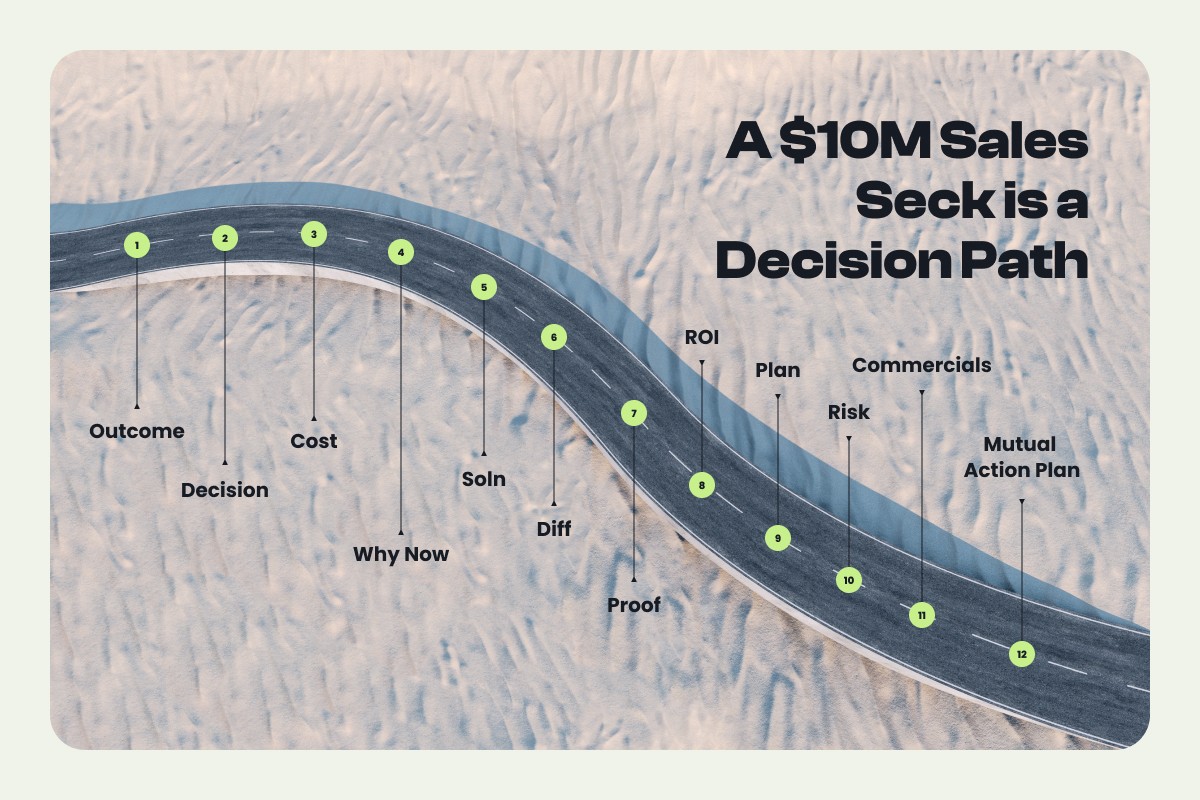
A $10M sales deck isn't a presentation. It's a decision path: it creates shared understanding fast, survives internal forwarding, and makes the next step feel inevitable.
Here's the anatomy, slide by slide.
Why $10M Decks Are Different: You're Selling Clarity to a Committee
Forrester puts the number at 13. That's how many people are involved in an average enterprise buying decision, and most purchases span multiple departments.
When a deal reaches this scale, your deck stops being something you present and starts being something that gets forwarded, annotated, debated, and reopened weeks later by people who weren't in the original meeting. Your deck has to work without you in the room.
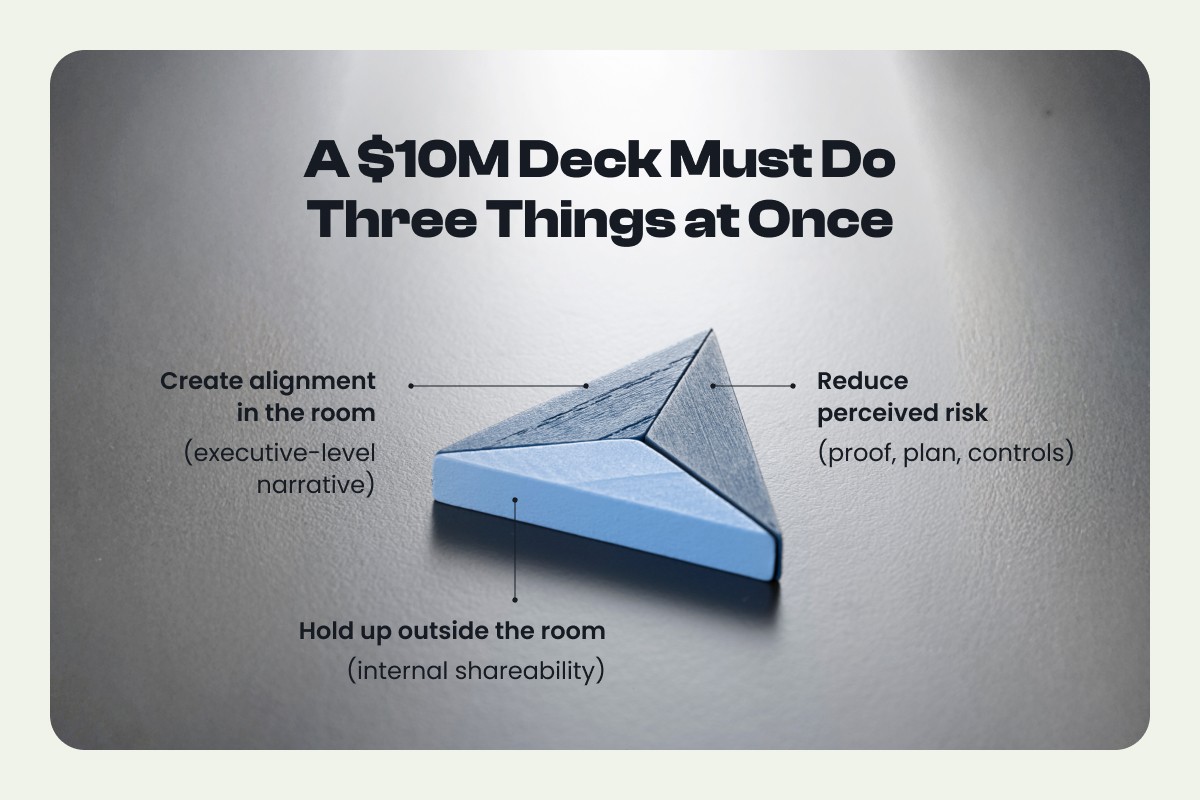
That means it must do three things at once. Create alignment among the people sitting in front of you, using an executive-level narrative they can all get behind. Hold up outside the room, surviving internal forwarding without losing its logic. And reduce perceived risk through proof, plan, and controls that answer the questions finance and legal will inevitably raise.
There's a cognitive constraint at play here too. When your slides force people to read, cross-reference, and interpret multiple sources at once, comprehension drops. Cambridge research calls this the split-attention problem: design that makes the audience do mental integration instead of decision-making.
A $10M deck isn't more detailed. It's more decisive.
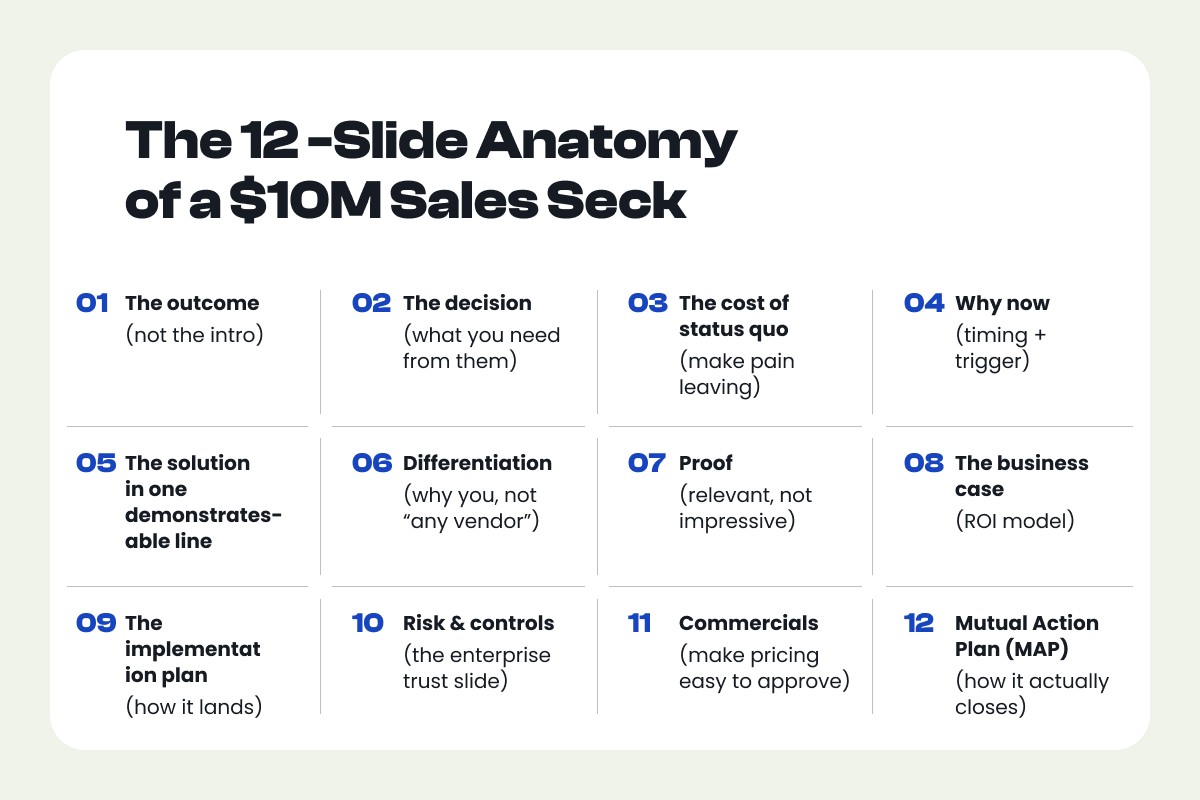
The 12-Slide Anatomy of a $10M Sales Deck
Below is the sequence we see consistently in decks that close, because each slide answers the next stakeholder question before it derails the meeting.
Slide 1: The Outcome (Not the Intro)
Most decks open with "About Us." The ones that close open with the finish line. One sentence stating the business outcome you'll deliver and how fast, three measurable changes, one relevant proof point. You anchor the meeting on value from the first second, before anyone has the chance to ask "so what does your company do?"
Slide 2: The Decision (What You Need From Them)
Enterprise deals don't die from bad pitches. They die in "nice meeting" limbo, where everyone leaves feeling positive and nothing moves. This slide prevents that. State today's goal explicitly: is it a pilot approval, a shortlist decision, a security review kickoff? Tell them what they'll see in the next 20 minutes and what happens after. When the ask is clear from the start, the conversation has direction.
Slide 3: The Cost of Status Quo (Make Pain Leaving)
Urgency in enterprise sales has to be rational, not emotional. Quantify what doing nothing costs per quarter, broken down by what each stakeholder actually cares about: revenue impact, time waste, compliance risk, operational drag. Pair it with a specific, realistic narrative example. "Doing nothing costs $X per quarter" is a far more powerful framing than "our product saves you money," and it's much harder to dismiss.
Slide 4: Why Now (Timing + Trigger)
This is the slide that gives your internal champion a reason to push this quarter instead of next. Identify the external trigger (market shift, regulation, technology change) and the internal trigger (contract renewal, initiative deadline, executive mandate). When both align, urgency becomes self-evident. Without this slide, even a great pitch lands as "something to revisit."
Slide 5: The Solution in One Demonstrable Line
If your solution can't be explained in one sentence, it can't be repeated internally. One diagram, one flow, no feature dump. "We solve [pain] by [mechanism], producing [outcome]." Translate for non-technical executives. The test: can your champion say this to their CFO in an elevator and have it land?
Slide 6: Differentiation (Why You, Not "Any Vendor")
Committees don't buy "best." They buy "least wrong." Three comparisons maximum, focused on the criteria that actually matter at enterprise scale: reliability, time-to-value, governance, security posture, support model. Skip the feature comparison matrix. The real question you're answering here is: what makes choosing someone else a risk they'd have to explain later?
Slide 7: Proof (Relevant, Not Impressive)
Enterprise buyers don't care that you work with Fortune 500 logos. They care that you've done this in environments like theirs. Two or three customers, one line each: what the problem was, what changed, what the result looked like. Industry and regulatory similarity matters far more than brand recognition. This slide reduces one specific fear: "Will this actually work for us, or are we the experiment?"
Slide 8: The Business Case (ROI Model)
This slide arms finance and executive stakeholders to defend the spend. Make the assumptions visible, not buried. Use range-based outcomes (best, base, worst) with a clear payback period. Conservative projections build more trust than optimistic ones. "5 to 8x ROI in year one" with transparent math beats "10x ROI" with no explanation, every time.
Slide 9: The Implementation Plan (How It Lands)
Every enterprise buyer has the same silent question: "Will this be chaos?" Answer it before they ask. Show phases (onboarding, pilot, rollout), what you need from them, and how success gets measured. A week-by-week plan with named owners and defined outputs signals that you've done this before and know how to land it.
Slide 10: Risk and Controls (The Enterprise Trust Slide)
Most $10M deals stall in perceived risk, not product value. Security, data handling, access controls, compliance, governance model, escalation paths: address them explicitly. Don't wait for procurement to surface these concerns. Show them you've already thought through everything they're about to ask.
Slide 11: Commercials (Make Pricing Easy to Approve)
Ambiguity in pricing stalls procurement. Offer two or three tiers (good, better, best) with clear differences tied to capabilities, speed, and support level. Include renewal logic upfront. The goal isn't just to close, it's to make the approval process straightforward enough that it doesn't become the bottleneck after everyone else has said yes.
Slide 12: Mutual Action Plan (How It Actually Closes)
This is the slide that converts interest into a shared timeline. If you want go-live by a specific date, map backwards: security review, legal, pilot, executive sign-off. Assign ownership clearly (what you handle vs. what they handle) and label decision gates explicitly. Every call after this one becomes MAP progress, not another "let's reconnect."
The Appendix Rule: What Separates $10M Decks from "Busy Decks"
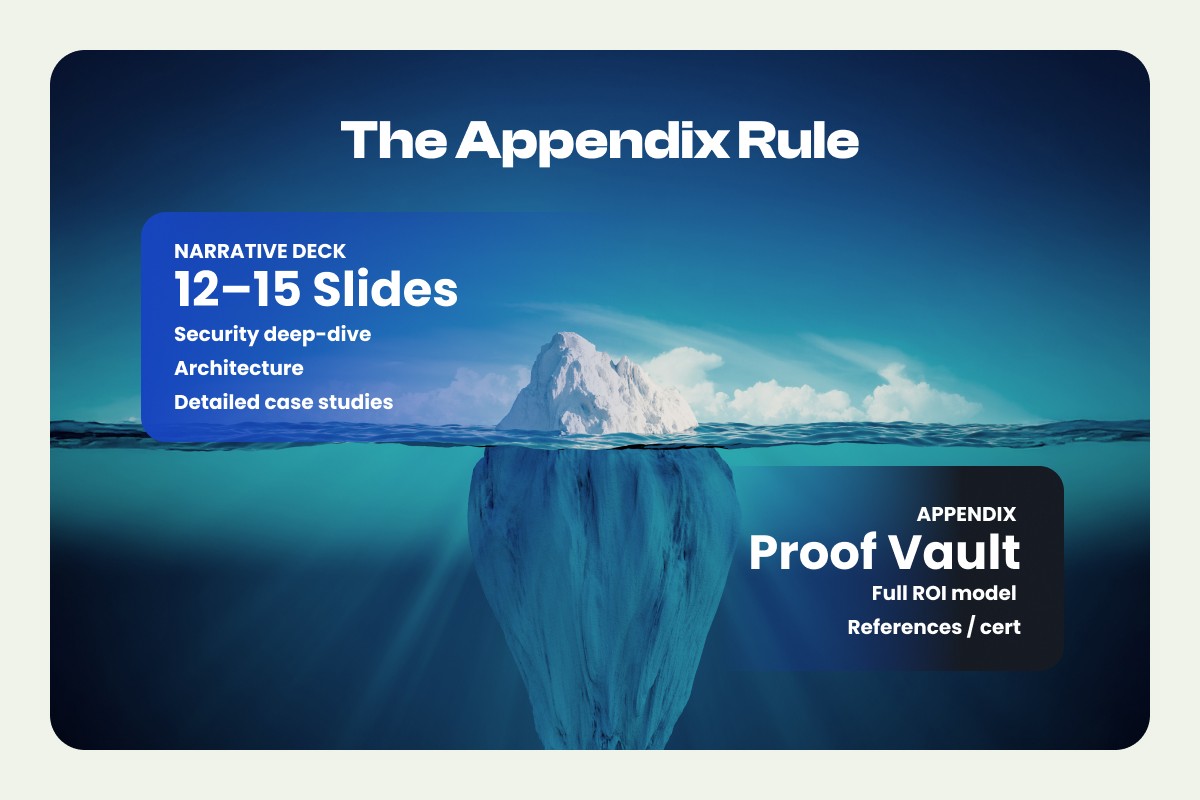
Your main deck should be 12 to 15 narrative slides. Everything else goes into a labeled appendix: security deep-dives, architecture diagrams, detailed case studies, the full ROI model, references, and certifications.
Think of it as an iceberg. The narrative deck is what's above the waterline: clean, decisive, built to move the room forward. The appendix is the Proof Vault below, instantly available when someone asks for depth but never cluttering the story.
This separation matters because of how attention actually works in a room. When everything is crammed into the main deck, you lose the audience in the details. When proof lives in a clearly labeled appendix, skeptics get what they need on demand and the rest of the room stays focused on the decision. Cambridge's research on the split-attention principle backs this up: forcing people to integrate multiple sources at once kills comprehension. Keep the narrative clean. Put proof where it's available, not where it's unavoidable.
The Transformation: What Changes When the Deck Becomes a Decision Path
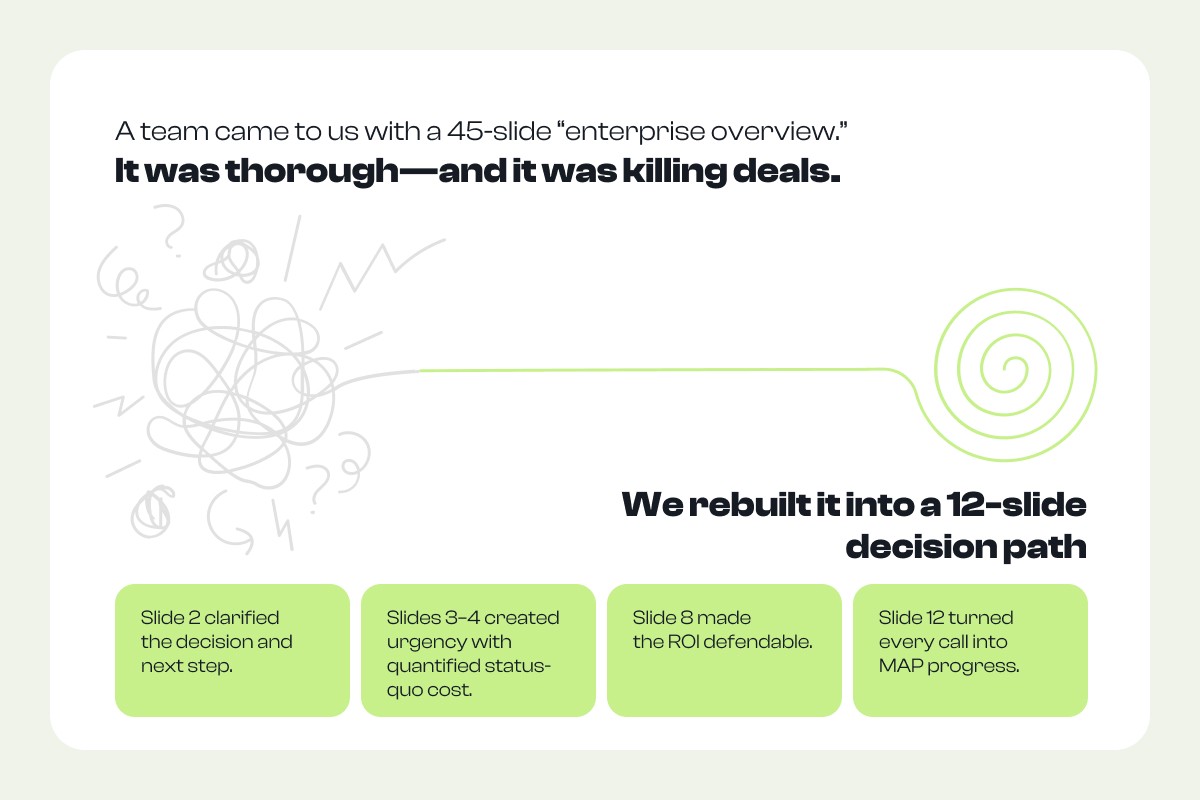
A team came to us with a 45-slide "enterprise overview." It was thorough, and it was killing deals.
The pattern never varied. Meetings ended with "send this over" but no decision. Stakeholders asked the same questions on every follow-up call. Champions couldn't summarize the value internally because the deck didn't give them a clear story to repeat.
We rebuilt it into a 12-slide decision path. Slide 2 clarified the decision and next step so every meeting had direction. Slides 3 and 4 created urgency with quantified status-quo cost and a timing trigger. Slide 8 made the ROI defendable with transparent assumptions. Slide 12 turned every subsequent call into MAP progress instead of another re-explain session.
The result: fewer "let me loop in my colleague" conversations, faster stakeholder alignment, and procurement entered later in the cycle because the deal was already internally agreed before it reached them.
Not prettier. Decisive.
Conclusion
A $10M deck doesn't win by saying more. It wins by making the buying group agree on the same story fast and giving them everything they need to defend it internally.
Use our Sales Deck Audit to score your current deck against this 12-slide anatomy, or book a Deck Review if the deal is live and high-stakes.