Presentations
Board Presentation Best Practices: Build a Decision-Ready Board Deck
•
8 Minutes
A board presentation isn't a performance. It's a decision mechanism.
And most board decks quietly work against that goal.
Not because the team didn't prepare. Not because the numbers are wrong. But because the deck answers the wrong question: management shows what happened, while directors are asking what should happen next and what could go wrong. When that gap stays open, the meeting turns into Q&A whack-a-mole, and the board asks for more materials instead of making decisions.
This is a guide to the board presentation best practices we use to build decks that earn trust, align quickly, and end with clear decisions.
The Real Cost of a Weak Board Deck Isn't Embarrassment. It's Drag.
Boards exist to govern and guide. Effective board meetings drive decision-making, accountability, and transparency, not page-turning. (Diligent)
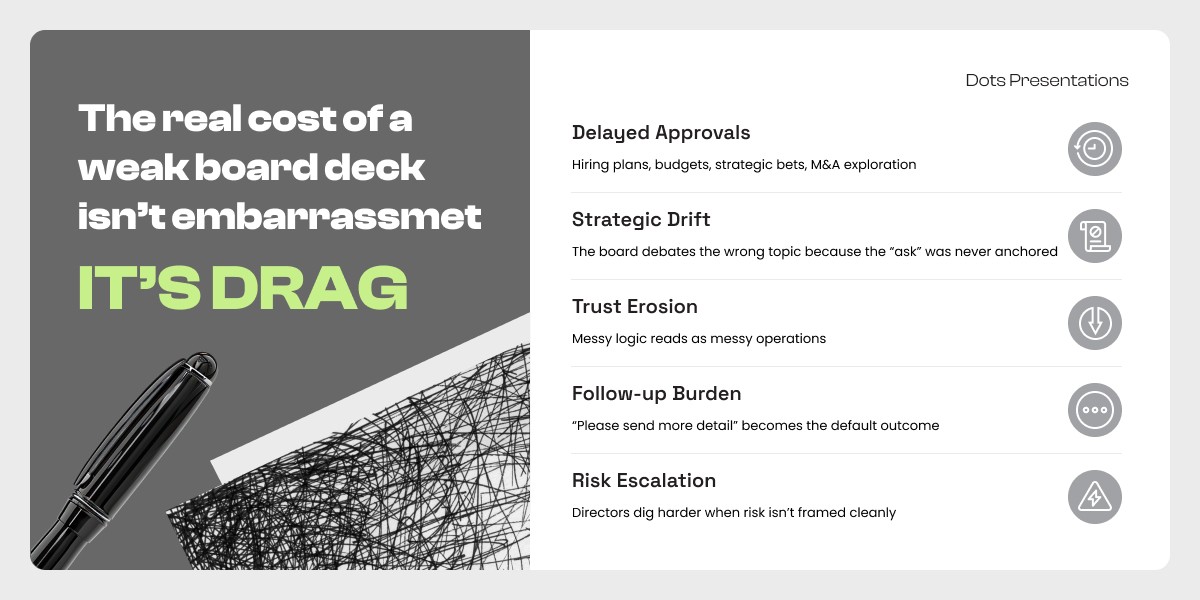
When board materials are unclear, the cost isn't just a bad meeting. It compounds. Hiring plans, budgets, and strategic bets get delayed because approvals stall. The board debates the wrong topic because the actual ask was never anchored. Messy logic reads as messy operations, and trust erodes quietly. "Please send more detail" becomes the default outcome. And when risk isn't framed clearly, directors dig harder, which changes the temperature of the relationship.
NACD has flagged this exact failure mode: board packs that are overly detailed, lengthy, and operational at the expense of strategy and decision readiness. That's not a formatting issue. It's a governance-performance issue.
Board Presentation Best Practices
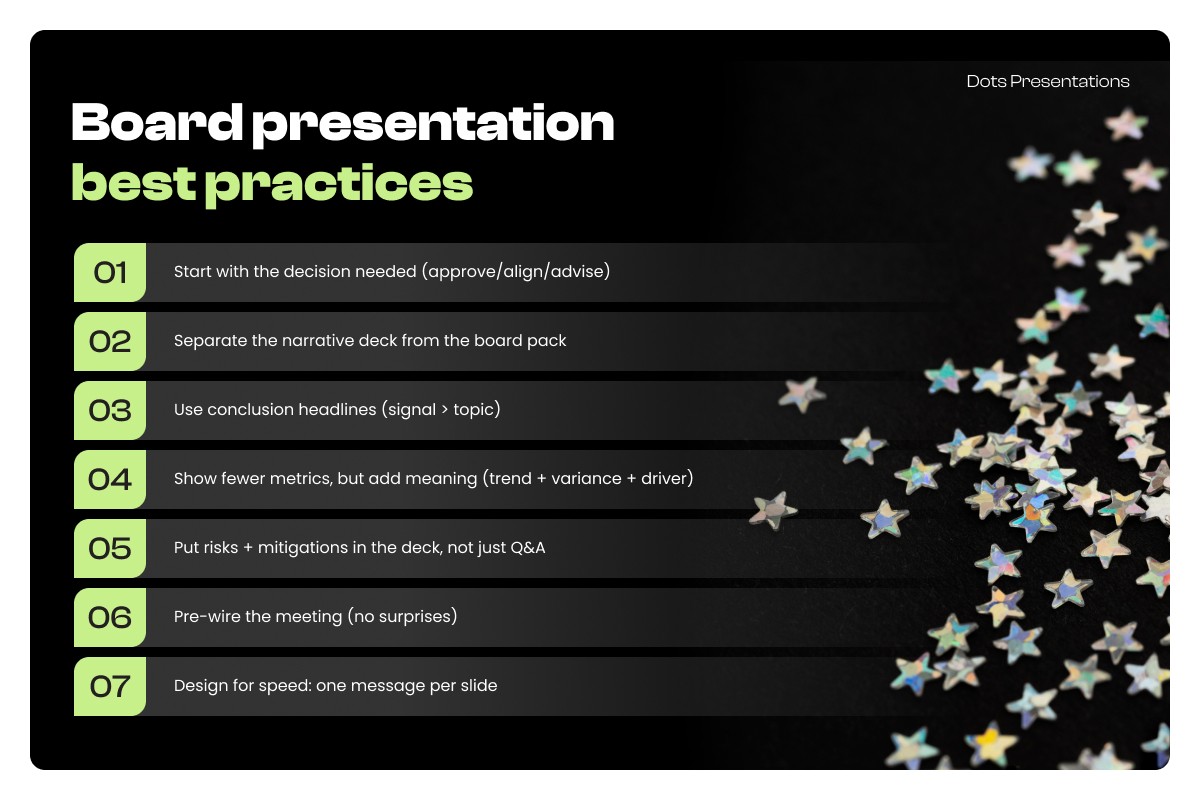
Seven practices separate decision-ready board decks from everything else:
Start with the decision needed (approve/align/advise)
Separate the narrative deck from the board pack
Use conclusion headlines (signal > topic)
Show fewer metrics, but add meaning (trend + variance + driver)
Put risks + mitigations in the deck, not just Q&A
Pre-wire the meeting (no surprises)
Design for speed: one message per slide
1. Start With the Decision, Not the Agenda
Most decks open with "Company Updates" or a list of topics. Directors spend the first ten minutes guessing what they're being asked to do.
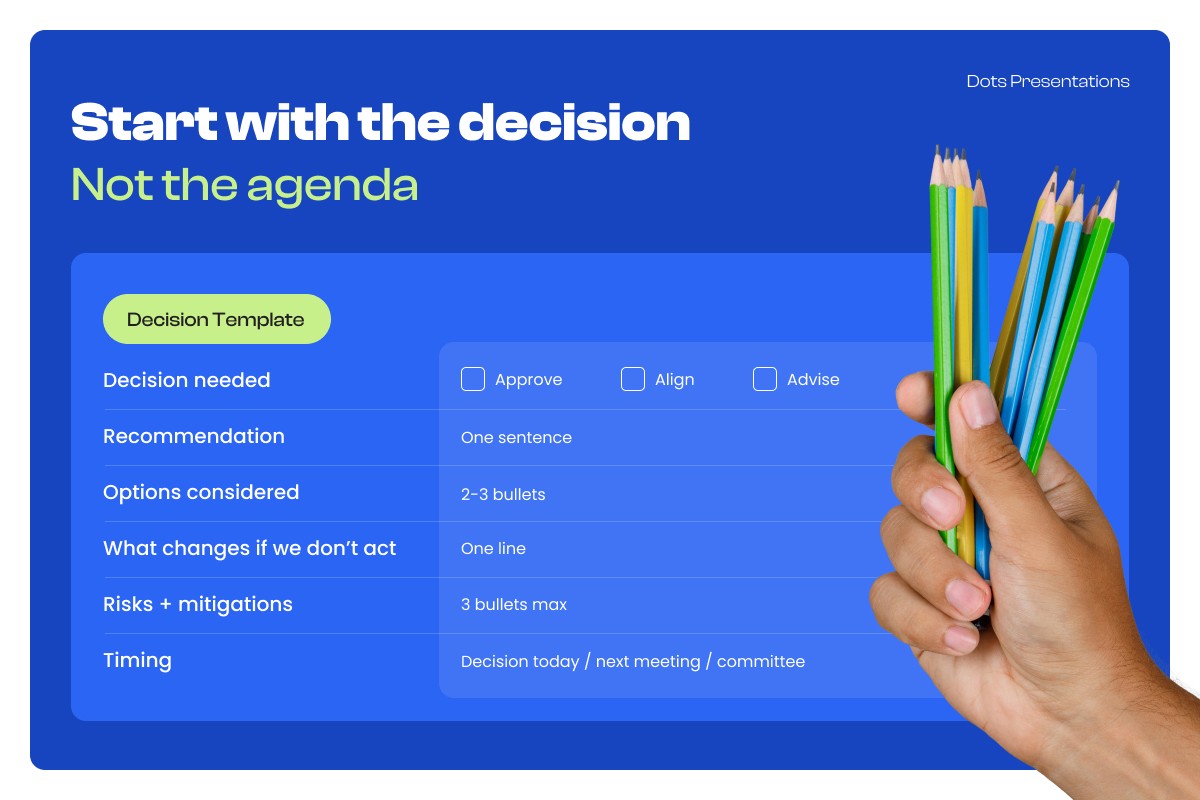
Slide 2 should be a Decision Slide. The format is simple and it changes how every meeting runs:
Decision Slide Template
Field | What to include |
|---|---|
Decision needed | Approve / Align / Advise |
Recommendation | One sentence |
Options considered | 2–3 bullets |
What changes if we don't act | One line |
Risks + mitigations | 3 bullets max |
Timing | Decision today / next meeting / committee |
This aligns with what board-facing guidance consistently emphasizes: directors want quick context refreshers, but more importantly the biggest problems to solve and a clear direction. (Harvard Business Review) When the ask is explicit from slide two, the rest of the meeting has somewhere to go.
2. Separate the Board Narrative From the Board Pack
There's a reason this mistake keeps happening: it feels responsible to include everything. More detail signals effort. More slides signal rigor.
It produces the opposite effect. When everything gets crammed into the main deck, directors scan rather than read, miss the signal, and ask for more.
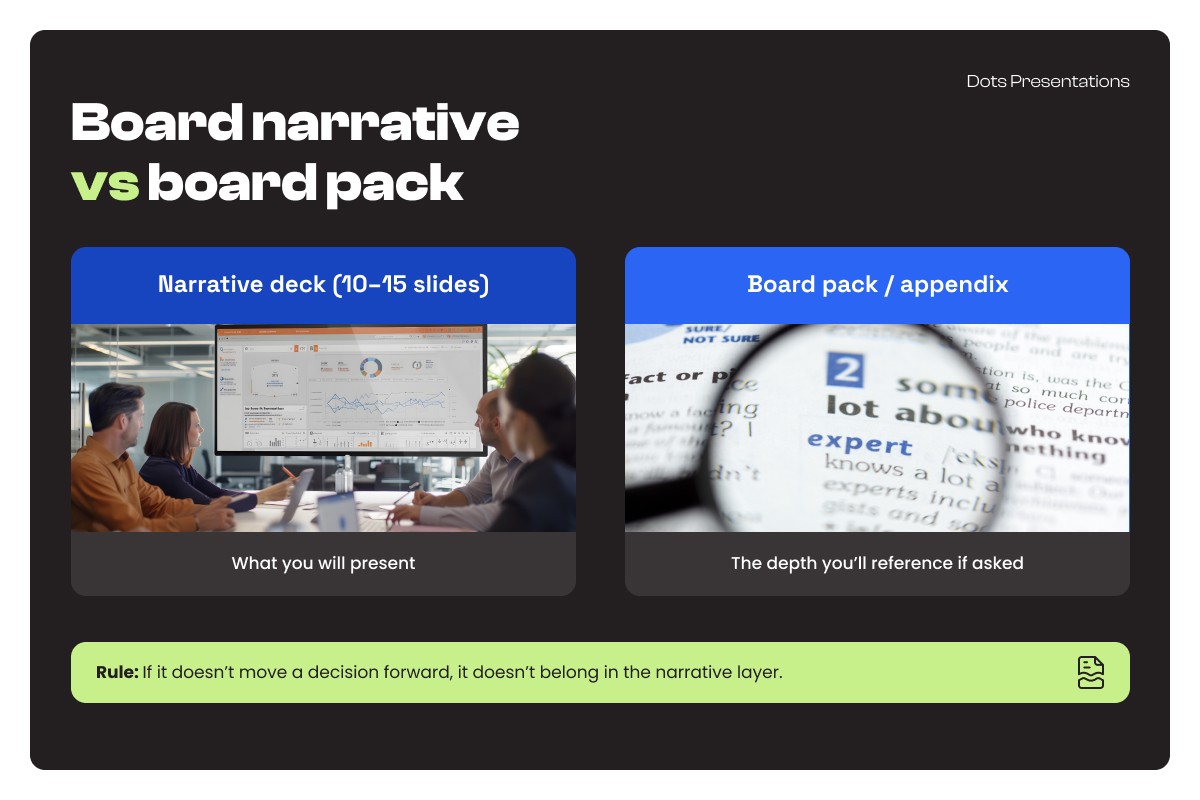
The fix is to create two distinct layers. The narrative deck, somewhere between 10 and 15 slides, is what you present. The board pack or appendix is the depth you reference if someone asks. Research on board materials highlights how packs become the "elephant in the boardroom" when they're bloated and unfocused. (NACD)
The rule is simple: if a slide doesn't move a decision forward, it doesn't belong in the narrative layer.
3. Use Conclusion Headlines, Not Topic Headlines
Boards interpret slides like forensic evidence. What you highlight signals priority. What you bury signals avoidance. What you can't explain signals risk.
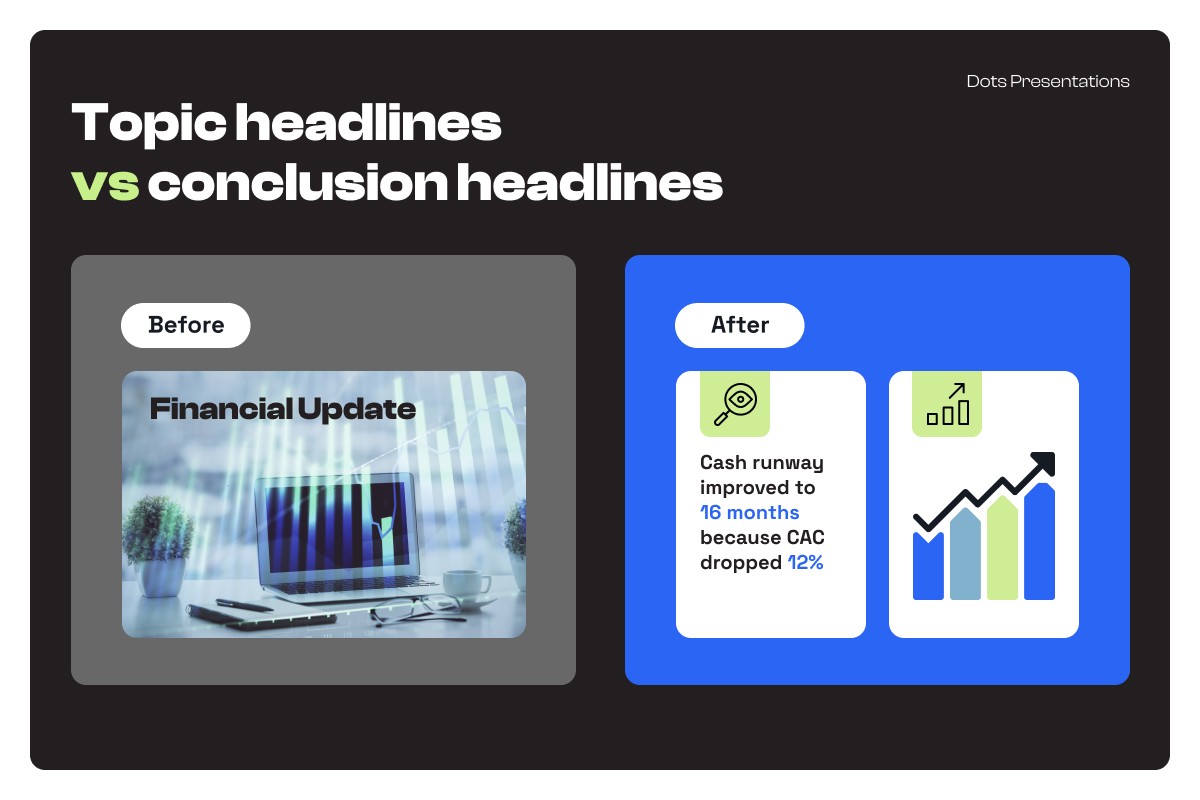
Topic headlines waste that signal. "Financial Update" tells a director nothing. "Cash runway improved to 16 months because CAC dropped 12%" tells them what changed, why it changed, and whether they need to worry. That's clarity that converts discussion into decision.
Every slide headline should be a conclusion, not a label. Before you finalize any slide, ask: if someone read only the headline, would they know what you want them to think or do? If the answer is no, rewrite the headline.
4. Metrics With Meaning
One of the strongest principles from investor and operator playbooks: the board deck should reflect the company's actual operating rhythm, drawing from dashboards the team already uses to run the business. (Bain Capital Ventures)
This matters for two reasons. It increases credibility, because "this is how we actually manage" is a far more powerful statement than custom board-only metrics assembled the night before. And it makes trend conversations faster, because the data has context that the team understands cold.
The format that works:
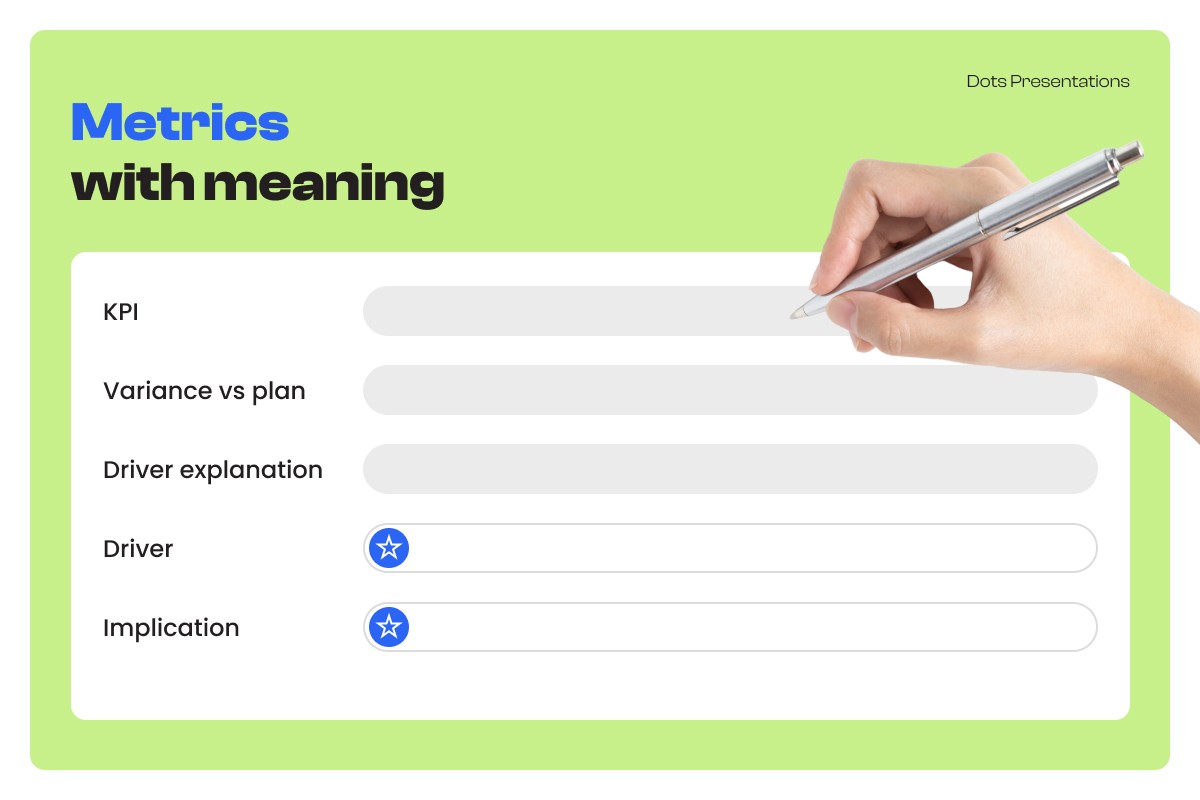
KPI / Variance vs plan / Driver explanation / Implication
Show fewer numbers. For each one, add the trend over the last six to eight periods, the variance against plan, one or two callouts explaining what drove it, and what you'll do next. A board can act on that. A table of seventeen metrics with no annotation cannot.
5. Put Risks and Mitigations in the Deck
When risk shows up only in Q&A, the board will assume you're reactive. Boards exist to govern risk. If it's not in the deck, you've left a vacuum, and directors will fill it with their own interpretation.
The structure that works:
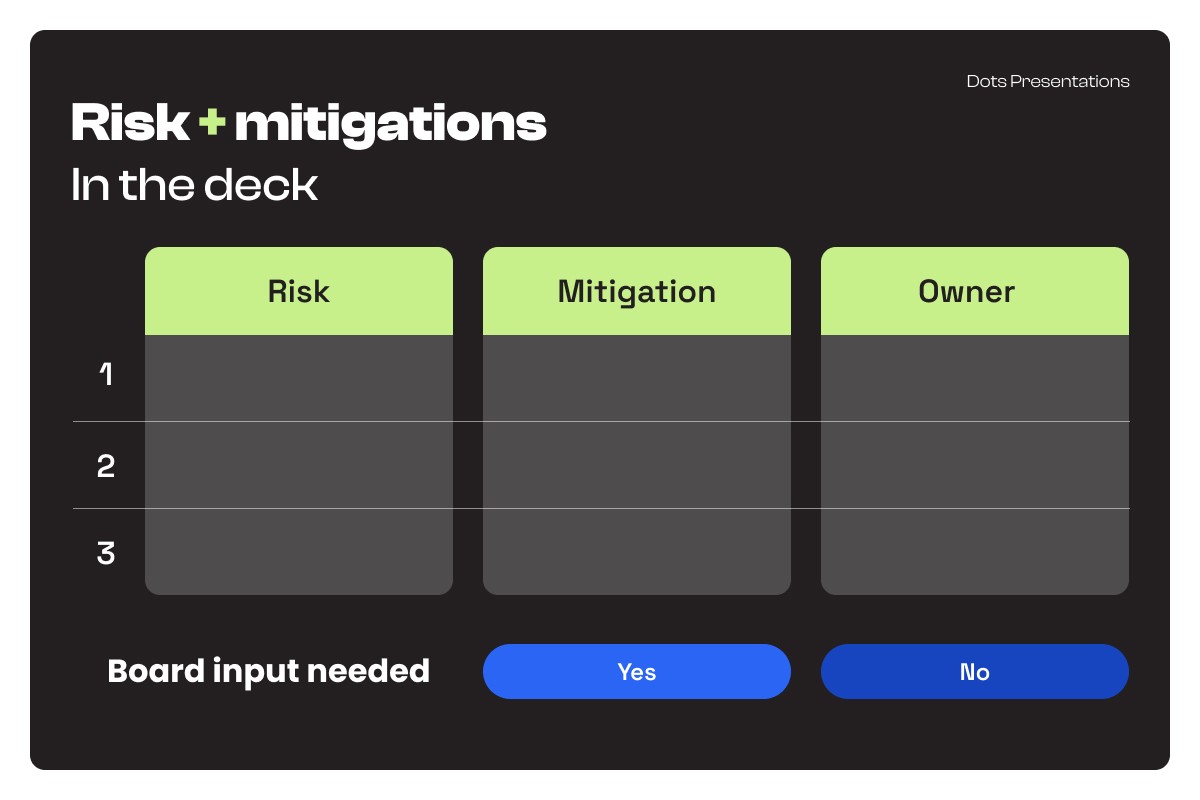
Risk / Mitigation / Owner
Show your top three risks, ranked. Note what's changed since the last meeting. Assign a mitigation plan and an owner to each. Then add one field that most teams skip: "Board input needed: yes / no." That last line steers the meeting toward valuable feedback and better oversight, rather than ending with a recap that doesn't change anything. (Harvard Business Review)
6. Pre-Wire the Meeting
The worst phrase in a boardroom is: "This is the first time I'm seeing this."
Board best practices consistently reward preparation, alignment, and no surprises. (Diligent) The meeting itself should be confirmation and refinement, not discovery and defensiveness.
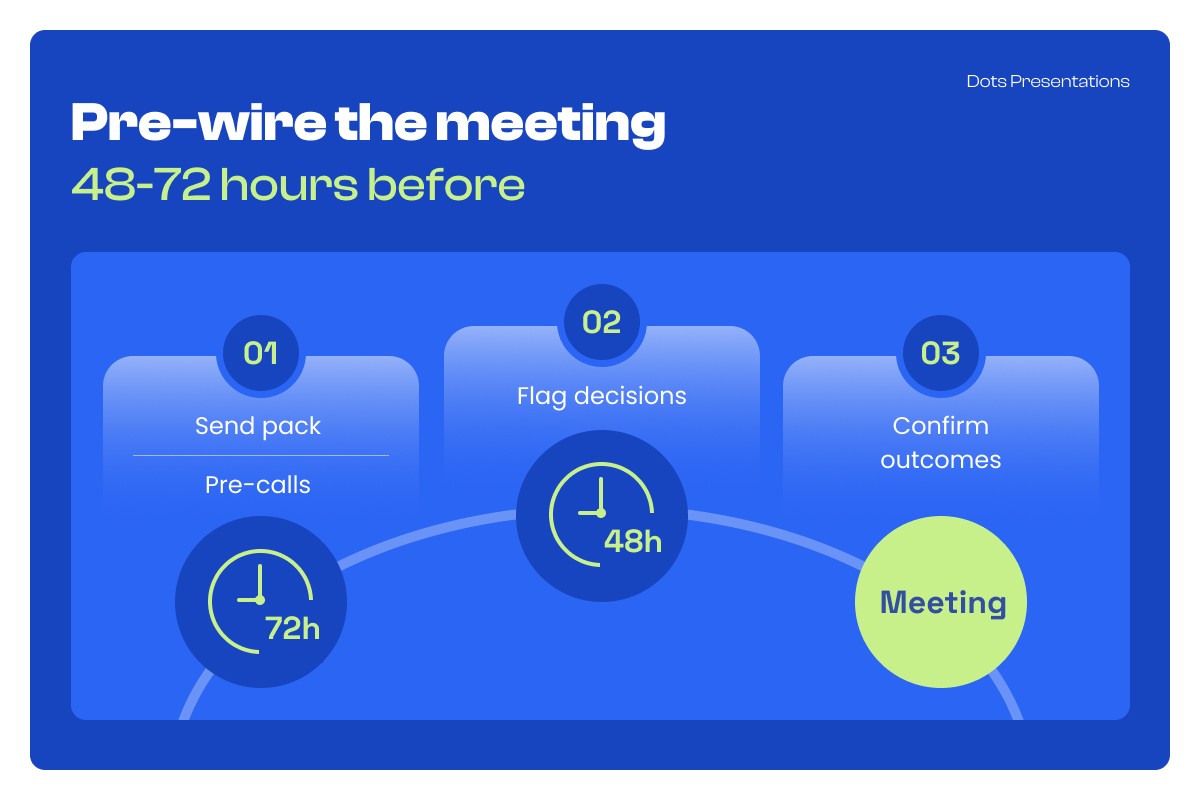
The pre-wire playbook runs 48 to 72 hours out:
72 hours before: Send the board pack. Make pre-calls to one or two directors who have context or strong opinions on the contentious items.
48 hours before: Flag the two or three decision points explicitly in the email body, not buried in the attachment.
At the meeting: Confirm outcomes, not facts.
Pre-wiring doesn't mean lobbying. It means not surprising people who are supposed to be governing you.
7. Design for Speed
You can have the right strategy and still lose the room because the slides are dense. In governance contexts, density signals one of two things: you can't prioritize, or you're hiding the truth in detail. Neither is a message you want to send.
NACD's research is direct on this: too much detail and too much operational content crowd out strategic usefulness.
Four non-negotiable design rules for board decks:
One message per slide
One chart per slide, maximum
28 to 32pt minimum body text (yes, really)
If a slide needs narration to make sense, it isn't ready
Use the appendix for proof. Keep the narrative deck clean.
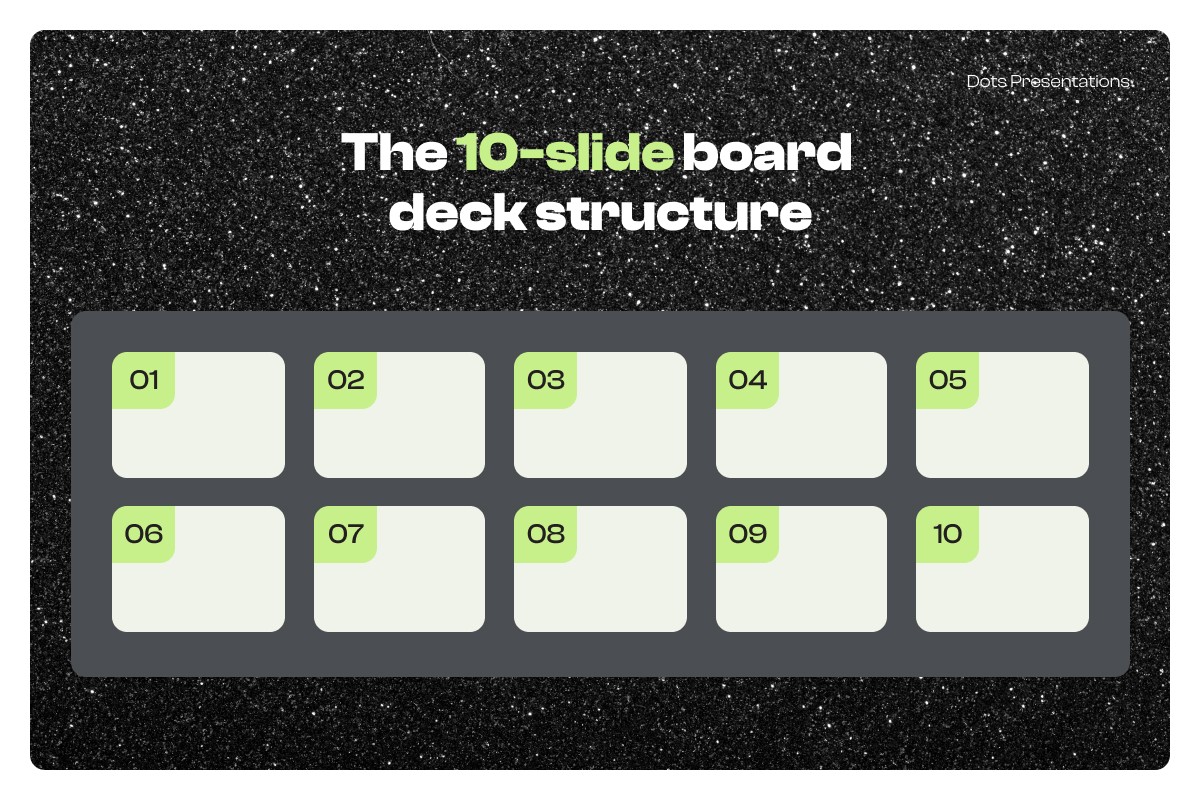
The 10-Slide Board Deck Structure
Investor and operator templates converge on a consistent principle: a board deck should structure discussion and decisions, not overwhelm. (Creandum) Here's the structure we recommend:
Meeting objective + decisions needed
CEO summary: what changed, what matters
Scorecard: 5–9 core KPIs (with meaning)
Financials: performance vs plan + runway
Strategic initiatives: 3 bets (progress, blockers, next step)
Market / competitive: the 2–3 shifts that matter
Risks + mitigations (ranked)
Org: leadership, hiring, capacity constraints
Asks: approvals, introductions, support needed
Appendix: deep dives by function
What Changes When the Deck Becomes a Decision Tool
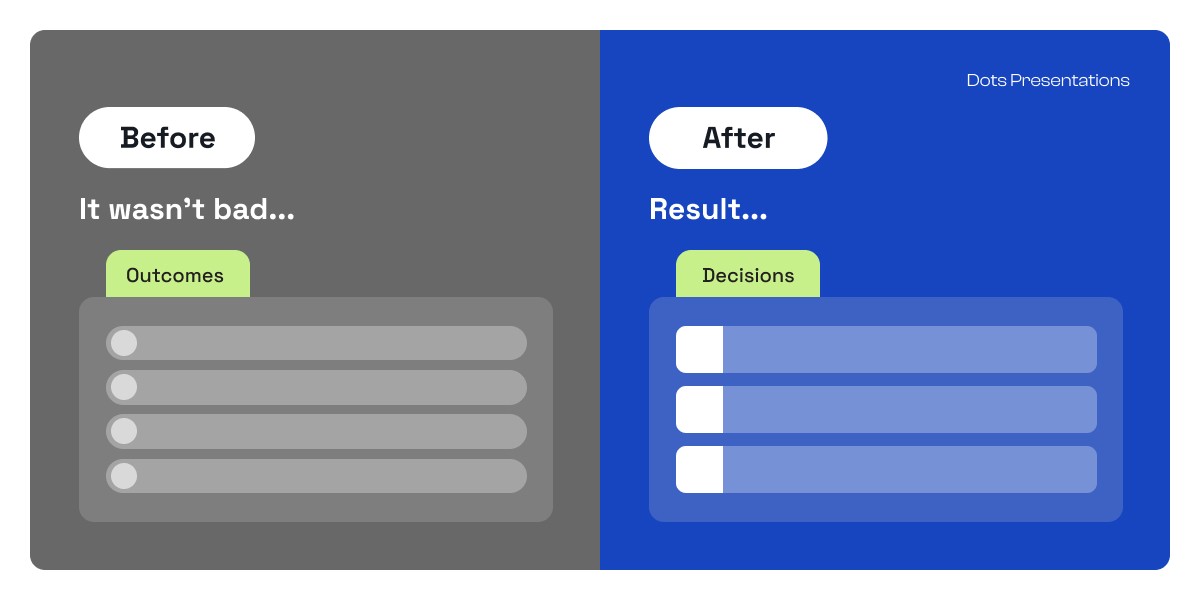
A CEO came in with a 45-slide board deck. It wasn't bad. Every function had updates. Every team had charts.
But the board meeting always ended the same way: lots of questions, little alignment, follow-up requests, decisions deferred.
We rebuilt the deck around three decisions the CEO actually needed: approve the revised hiring plan, align on international expansion sequencing, and validate the pricing shift and risk plan. We cut the narrative deck to 13 slides, moved operational detail into a labeled appendix, and rewrote every headline as a conclusion.
The meeting shifted from reporting to governing. Decisions landed in-session. The CEO left with clear next steps and fewer follow-ups, not because there was less rigor, but because the rigor was organized around decisions.
Conclusion
Board presentation best practices aren't about polish. They're about building a decision path that reduces cognitive load, increases trust, and makes board time produce outcomes.
Use the Board Deck Decision Checklist or book a deck review for your next board meeting.